
The Wildflower Journal
12 August 2026
The Wildflower Journal
14 August 2026
No Is a Full Sentence: Learning to Set Boundaries Without Guilt
I used to think being a good person meant being accommodating, understanding, patient and forgiving. Saying yes when I really wanted to say no because I didn’t want to upset anyone. Explaining myself over and over because I needed people to understand why I felt the way I did. Giving another chance, then another, then probably another one for good measure.
Basically, keeping everybody else comfortable while quietly making myself uncomfortable. And I’m learning that isn’t kindness. It’s abandoning yourself.
Think about how often we say things like, “No, sorry, I can’t because…” or “No, I would but…” We soften it, apologise for it and wrap it in enough explanation that hopefully the other person won’t think we’re horrible.
But sometimes the answer is simply no.
Not because we’re angry. Not because we don’t care. Not because we’re trying to punish somebody. Just because something doesn’t feel right for us. And that should be enough.
I think for a long time I misunderstood what having boundaries actually meant. Setting a boundary doesn’t mean shutting everybody out or becoming cold and uncaring. Actually, I think healthy boundaries allow us to love people better.
I can love someone and disagree with them. I can care about someone and still say no to them. I can understand why somebody behaves the way they do without accepting behaviour that hurts me. I can forgive someone without giving them unlimited access to me. And I can choose myself without making somebody else the villain.
Those things can exist at the same time.
Learning to set a boundary is one thing. Learning not to feel guilty afterwards is another bloody story. 😂 Especially if you’re used to being the person who fixes things, keeps everybody happy, gives people the benefit of the doubt or automatically puts yourself at the bottom of the list.
When you start changing that, it can feel uncomfortable. Sometimes other people won’t like it either. But somebody being unhappy with your boundary doesn’t automatically mean your boundary is wrong.
That’s something I’m learning to remember. Discomfort doesn’t always mean we’ve done something bad. Sometimes discomfort simply means we’re doing something differently.
My peace matters. Your peace matters.
We don’t have to reach complete exhaustion before we’re allowed to step away. We don’t need somebody else to agree that something was “bad enough” before we’re allowed to decide we don’t want it in our lives. And we definitely don’t need to write a dissertation explaining every decision we make. 😂
Sometimes protecting your peace looks dramatic, but most of the time I think it’s actually really quiet. It’s not replying immediately. It’s leaving the conversation. It’s saying, “I’m not comfortable with that.” It’s changing your mind. It’s deciding you don’t have the energy today. It’s refusing to participate in something that doesn’t feel good for you.
And sometimes it’s simply saying no.
No argument. No elaborate explanation. No guilt.
You are allowed to have boundaries. You are allowed to change them. You are allowed to decide who and what gets access to your time, your energy and your peace.
The people who genuinely care about you might not always like every boundary you set — we’re all human — but they will learn to respect them. And if somebody only likes you when you have no boundaries at all? Maybe that tells you something too.
So today I’m reminding myself:
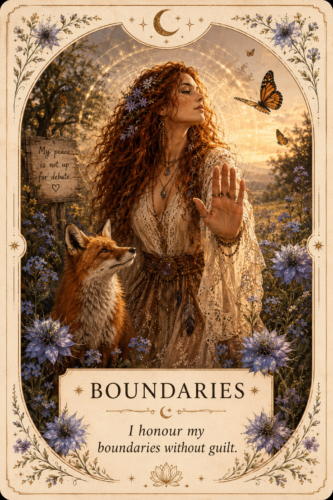
I honour my boundaries without guilt.
I can be loving without abandoning myself. I can be kind without saying yes to everything. And “no” really can be a full sentence.