

Welcome to The Breathing Room
When everything feels loud, busy or simply too much, you don’t need to fix everything at once.
This is your space to slow things down.
You don’t need to be productive here. You don’t need to have the answers. Take what you need, leave what you don’t, and give yourself permission to deal with this moment before the next one.
Pause. Breathe. Reset.
Start here
If your mind is racing
Bring your attention away from everything demanding it and back to something simple: your breath, your body, or what you can see and feel around you.
If everything feels urgent
Ask yourself: What actually needs my attention right now? Not today. Not this week. Just right now.
If you don’t know what you need
That’s okay too. Choose one of the gentle practices below and let that be enough for the next few minutes.
A gentle 5-minute reset
Pause — put down whatever you’re doing if you can.
Unclench — soften your jaw, drop your shoulders and relax your hands.
Breathe — take a few slow, comfortable breaths without forcing them.
Ground — notice five things you can see, four you can feel, three you can hear.
Choose one thing — decide what deserves your attention next. Everything else can wait.
Things that might help right now

When Your Mind Feels Too Loud
Sometimes our thoughts move faster than we can keep up with them — jumping from one worry to another, replaying conversations, planning ahead or trying to solve everything at once.
You don’t need to force your mind to become completely quiet. These gentle practices are here to help you slow things down, reconnect with the present moment and give your mind somewhere softer to land.
Choose whatever feels right for you today. There’s no perfect way to do this — just a few simple things you can try when your thoughts feel particularly busy.
Brain Dump — Get It Out of Your Head
Grab a notebook and write down everything currently circling your mind. Don’t organise it, edit it or try to make it pretty — just get it out.
When you’re finished, look over what you’ve written and gently ask yourself:
What actually needs my attention right now?
What can wait?
What isn’t mine to solve?
Sometimes seeing our thoughts on paper can make them feel a little less tangled.
Name the Thought — Don’t Chase It
When the same thought keeps appearing, try noticing what your mind is doing rather than immediately following wherever the thought wants to take you.
You might notice:
“I’m worrying about tomorrow.”
“I’m replaying that conversation.”
“I’m trying to predict what might happen.”
You don’t have to answer or solve the thought. Simply notice it, name it and gently bring your attention back to what you’re doing now.
Choose one small, physical thing to focus on.
Make yourself a warm drink. Fold some washing. Colour or draw. Water your plants. Take a slow walk. Sit outside for a few minutes. Stroke your pet. Light a candle and watch the flame.
For the next few minutes, that is the only thing you need to do.
You’re not trying to fix everything. You’re simply giving your attention somewhere gentle to rest.
Still Feeling Busy?
You can stay here a little longer or try another gentle practice within Nova Rising Soul.
Try Box Breathing to give your attention a simple breathing rhythm.
Put on a calming playlist and let yourself listen without doing anything else.
Try a gentle yoga flow to bring some of that attention out of your thoughts and into your body.
Open your journal and give whatever is circling your mind somewhere to go.
You don’t need to untangle every thought today.
Sometimes it’s enough to pause, breathe, and come back to now. 🌙
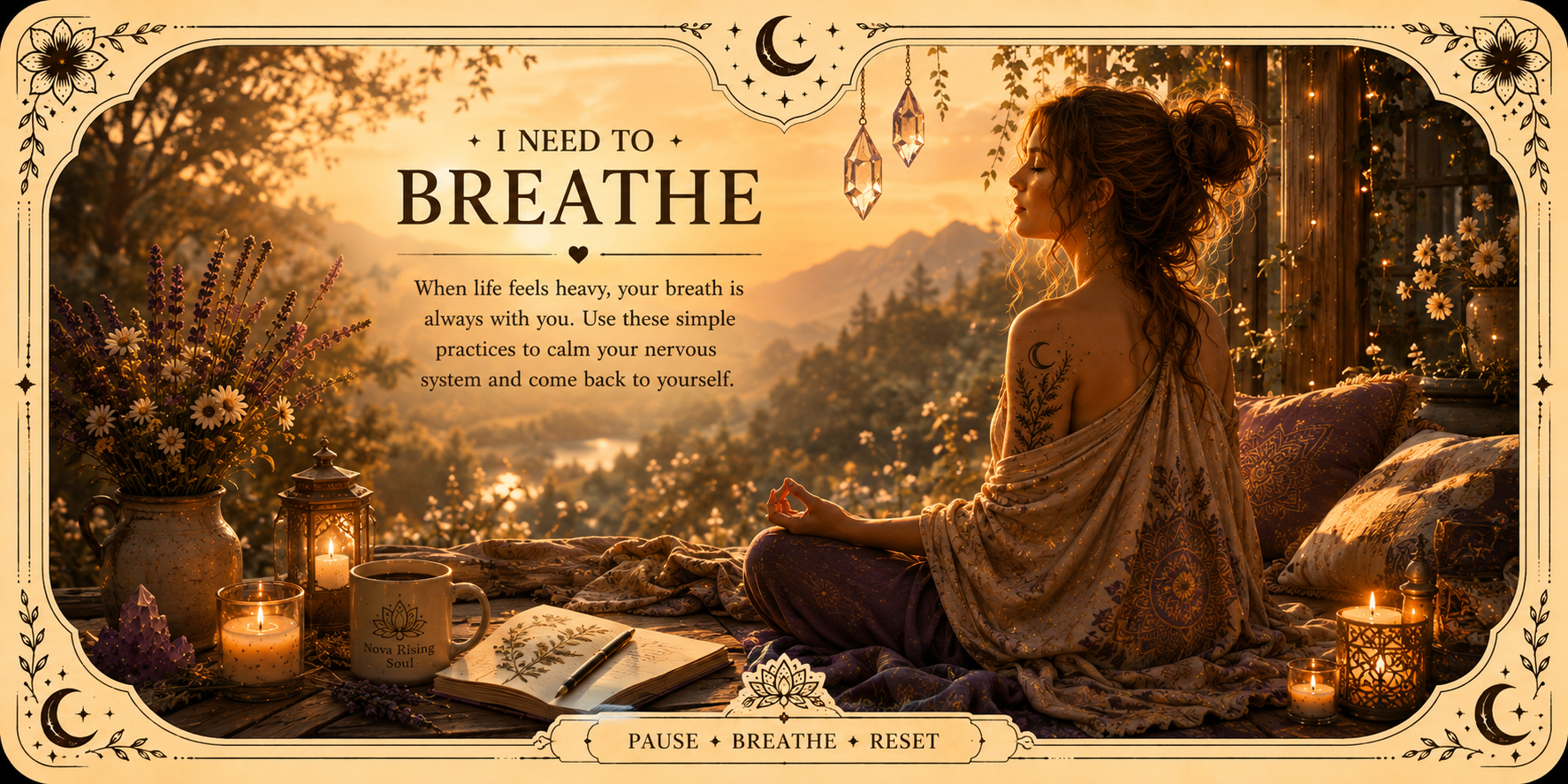
Come Back to Your Breath
Your breath is something you carry with you everywhere. When life feels busy, overwhelming or simply a little too much, taking a moment to notice your breathing can give you one small thing to focus on.
You don’t need to breathe perfectly, empty your mind or force yourself to feel calm. Choose whichever practice feels comfortable today and let your breath become a gentle anchor back to the present moment.
Longer Exhale — Slow Things Down
Find a comfortable position and allow your breathing to settle naturally.
Gently breathe in through your nose, then let your exhale last a little longer than your inhale.
For example:
Breathe in for 3
Breathe out for 5
Continue for a few comfortable rounds. There’s no need to force the breath or reach a particular number — simply allow the exhale to become a little slower and softer.
Five-Finger Breathing — Breathe & Trace
Hold one hand out in front of you with your fingers spread.
Using the index finger of your other hand, slowly trace around your fingers.
Trace up a finger as you breathe in.
Trace down as you breathe out.
Continue until you’ve travelled around your whole hand.
It gives your mind something physical to concentrate on while you breathe, making it a lovely little practice when sitting still feels difficult.
Hand-on-Heart Breathing — Come Back to Yourself
Place one hand over your heart and the other over your stomach.
Before changing anything, simply notice your natural breathing beneath your hands.
Feel your body move as you breathe in.
Feel it soften as you breathe out.
Stay here for a few breaths and quietly remind yourself:
I am here. I only need to be in this moment.
Five Gentle Breaths — When You Only Have a Minute
You don't always need a long practice.
Wherever you are, pause and take five slow, comfortable breaths.
With each inhale, notice the air entering your body.
With each exhale, consciously soften somewhere — your shoulders, jaw, hands or forehead.
If your thoughts wander halfway through, simply come back to the next breath.
Sigh It Out — Let Something Go
Take a comfortable breath in through your nose.
Then gently sigh it out through your mouth.
As you exhale, let your shoulders drop, loosen your jaw and relax your hands.
You can repeat this a few times if it feels good.
You don't have to imagine releasing anything profound. Sometimes a sigh can simply be a sigh.
Follow Your Natural Breath — Nothing to Change
This one is perhaps the simplest of all.
Close your eyes if that feels comfortable and notice your breathing exactly as it is.
Don't deepen it.
Don't slow it.
Don't count it.
Simply notice in... and out.
When your thoughts wander, gently return your attention to your next breath.
Spend thirty seconds here, a minute, five minutes — whatever feels right.
A Gentle Reminder
Breathing practices should feel comfortable. You don't need enormous breaths, lengthy breath holds or complicated techniques for your breath to become a useful anchor.
If a practice makes you feel dizzy or uncomfortable, stop and return to your normal breathing.
Some days you might spend ten minutes here.
Other days, you might simply close your eyes and take one intentional breath.
Both count.
Your breath is always somewhere you can return to.

Clear Some Space
Sometimes your head feels crowded even when you can’t pinpoint one particular reason. Thoughts overlap, unfinished tasks hover in the background, decisions keep going round in circles and suddenly everything feels louder than it needs to.
You don’t have to empty your mind completely. The aim is simply to separate some of the noise, work out what deserves your attention and give yourself a little more mental breathing room.
Choose whichever practice feels useful today.
What Is Actually Taking Up Space?
Instead of writing everything down, pause and ask yourself one question:
What is taking up the most space in my head right now?
Try to choose just one thing.
Then ask:
Can I do something about this right now?
If yes, what is the smallest useful action you could take?
If no, give yourself permission to put it down for now.
You can even tell yourself:
“I don’t need to solve this in this moment.”
Now, Later or Not Mine
When several things are competing for your attention, mentally place each one into one of three categories:
NOW — This genuinely needs my attention today.
LATER — This matters, but it can wait.
NOT MINE — This is outside my control or belongs to somebody else.
You might be surprised how much of what you're mentally carrying doesn't actually belong in NOW.
The One-Thing Reset
Look around you and choose one small thing you can complete from beginning to end.
Clear one surface.
Reply to one message.
Put away five things.
Make your bed.
Water a plant.
Make yourself a drink.
Then do only that.
Finishing one small, visible task can give your attention a clear beginning and end when everything else feels scattered.
Change Your Scenery
Sometimes your thoughts need an interruption rather than another technique.
Move somewhere different.
Step outside.
Open a window.
Sit on the floor instead of the sofa.
Take your drink into the garden.
Walk around the block.
You’re not running away from your thoughts — you’re simply giving your senses something new to notice.
While you're there, look around and find one thing you hadn't noticed before.
The Mental Parking Space
If something keeps returning but you genuinely cannot deal with it right now, decide when you will come back to it.
Instead of:
“I need to remember to sort that.”
Try:
“I’ll look at this tomorrow morning.”
Or:
“I'll deal with this after dinner.”
Put a reminder somewhere if necessary, then allow yourself to stop rehearsing it.
Your brain doesn't need to keep reminding you once you've given the thought somewhere to go.
Ask Yourself: What Do I Need?
Sometimes a busy head isn't asking for another solution.
Ask yourself:
Do I need quiet?
Do I need movement?
Do I need food or water?
Do I need fresh air?
Do I need company?
Do I need some time alone?
Do I need to stop for a while?
Then, where possible, give yourself the simplest version of that thing.
Before You Move On
Take a moment and ask:
What needs my attention?
What can wait?
What can I put down completely?
You don't need a perfectly clear mind before continuing with your day.
Sometimes clearing your head simply means going from everything at once to one thing at a time.

You Don’t Have to Carry Everything
When your plate feels too full, the answer isn’t always finding a better way to squeeze more onto it.
Sometimes something needs to come off.
We can easily fall into the habit of treating everything as equally important — every task, request, responsibility, message and expectation becomes something we should be able to manage.
But you have limited time and energy, and choosing not to do something right now doesn’t mean you’ve failed.
This page is about looking at what you’re carrying and asking:
What genuinely needs me — and what can I put down?
The Three-List Reset — Need To, Could Do, Not Today
Take whatever is currently demanding your attention and divide it into three simple categories.
NEED TO — Things that genuinely need doing today.
COULD DO — Things it would be nice to get done, but nothing terrible happens if they wait.
NOT TODAY — Things you are deliberately choosing not to give your energy to today.
For example:
Need to: Pick up a prescription, feed the pets, make dinner.
Could do: Vacuum upstairs, reply to a non-urgent message, sort a cupboard.
Not today: Reorganise the entire house, solve next month's problems, answer messages you don't have the energy for.
The important part is that Not Today is a decision, not a failure.
The Minimum Version — Make It Smaller
Look at something on your plate and ask:
“What would the easiest acceptable version of this look like?”
Dinner doesn't have to be cooked from scratch.
The whole house doesn't need cleaning — perhaps you clear one room.
You don't need an hour-long workout — maybe you stretch for ten minutes.
You don't need to reply to every message — answer the important one.
You don't always need to remove something completely.
Sometimes you can simply make it smaller.
Who Said I Have To?
Pick something that's creating pressure and ask yourself:
Do I genuinely need to do this?
Do I want to do this?
Or do I just feel like I should?
Sometimes the pressure isn't coming from an actual responsibility at all. It's coming from expectations we've placed on ourselves.
If the only reason you're doing something is “because I should,” you're allowed to question whether it belongs on your plate.
Delegate, Delay or Delete
Take one thing that's weighing on you and decide whether you can:
DELEGATE IT — Can somebody else help or take responsibility for part of it?
DELAY IT — Does this genuinely need doing today?
DELETE IT — What actually happens if you simply don't do it?
Not everything can be delegated or removed, of course.
But you might find that you've been treating “I could do this” as “I absolutely must do this.”
Choose Your Three
If your to-do list feels endless, stop trying to finish the whole thing.
Choose three things that would make today feel enough.
They don't have to be impressive.
For example:
1. Make the phone call I've been putting off.
2. Put one load of washing on.
3. Make myself something decent to eat.
Anything else you accomplish is extra.
When those three things are done, you're allowed to recognise that you've done what mattered today instead of immediately moving the finish line.
Give Yourself Permission
Sometimes we already know what needs to come off our plate.
We're simply waiting for permission.
So here it is:
You can say no.
You can change your mind.
You can ask for help.
You can do the easier version.
You can leave something until tomorrow.
You can decide something isn't important anymore.
You can rest before everything is finished.
Before You Move On
Ask yourself:
What genuinely needs me today?
What could wait?
What could somebody else help with?
What am I doing purely because I think I should?
What would I take off my plate if I knew nobody would judge me for it?
Then choose one thing to put down.
You don't have to earn the right to make life a little lighter.
Sometimes looking after yourself means asking “How can I manage all of this?”
And sometimes it means asking:
“Why am I trying to do all of this in the first place?”